Author:
Evaluation:
Published: 08.05.2009.
Language: English
Level: College/University
Literature: 6 units
References: Not used
  • Research Papers 'Three Different Views on Polysyndeton and Asyndeton', 1.
  • Research Papers 'Three Different Views on Polysyndeton and Asyndeton', 2.
  • Research Papers 'Three Different Views on Polysyndeton and Asyndeton', 3.
Extract


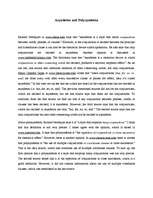
Richard Nordquist in www.about.com says that “asyndeton is a style that omits conjunctions between words, phrases, or clauses.” However, is the conjunction is omitted between the principal and subordinate clause it can also be the rhetorical device called apokoinou. He also says that only conjunctions are omitted in asyndeton. Another opinion is discussed in www.thefreedictionary.com. The dictionary says that “asyndeton is a rhetorical device in which conjunctions or other connecting words are omitted, produced a staccato, emphatic effect.” As we can see, this source also mentions omission of other connecting words, not only conjunctions. Shruti Chandra Gupta in www.literaryzone.com writes that “when conjunctions (but, for, so, or, and) are done away with after every successive clause or phrase for effect, then it’s called asyndeton.” In this case we can see that the author has listed all the conjunctions that are omitted in asyndeton (i.e. but, for, so, or, and). …

Author's comment
Send to email

Your name:

Enter an email address where the link will be sent:

Hi!
{Your name} suggests you to check out this eKönyvtár paper on „Three Different Views on Polysyndeton and Asyndeton”.

Link to paper:
https://eng.ekonyvtar.eu/w/378966

Send

Email has been sent