Author:
Evaluation:
Published: 25.01.2011.
Language: English
Level: Secondary school
Literature: 4 units
References: Not used
Time period viewed: 2009.g. - 2010.g.
  • Presentations 'Permafrost and Soil Fluction', 1.
  • Presentations 'Permafrost and Soil Fluction', 2.
  • Presentations 'Permafrost and Soil Fluction', 3.
  • Presentations 'Permafrost and Soil Fluction', 4.
  • Presentations 'Permafrost and Soil Fluction', 5.
  • Presentations 'Permafrost and Soil Fluction', 6.
  • Presentations 'Permafrost and Soil Fluction', 7.
  • Presentations 'Permafrost and Soil Fluction', 8.
  • Presentations 'Permafrost and Soil Fluction', 9.
  • Presentations 'Permafrost and Soil Fluction', 10.
  • Presentations 'Permafrost and Soil Fluction', 11.
  • Presentations 'Permafrost and Soil Fluction', 12.
  • Presentations 'Permafrost and Soil Fluction', 13.
  • Presentations 'Permafrost and Soil Fluction', 14.
  • Presentations 'Permafrost and Soil Fluction', 15.
  • Presentations 'Permafrost and Soil Fluction', 16.
  • Presentations 'Permafrost and Soil Fluction', 17.
Table of contents
Nr. Chapter  Page.
  Permafrost   
  Soil Fluction   
  Result on this phenomens   
  Forms of Permafrost   
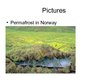
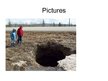
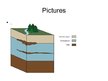
  Some pictures and Descriptions   
Extract

Result of Soil Fluction
In geology, solifluction, also known as soil fluction, is a type of mass wasting where waterlogged sediment moves slowly downslope, over impermeable material. It occurs in periglacial environments where melting during the warm season leads to water saturation in the thawed surface material (active layer), causing a form of downslope "flow" to occur. This "flow" is due to frost heave that occurs normal to the slope, as well as to small-scale slippage. Where the underlying ground is permanently frozen (permafrost) the process is often called gelifluction.

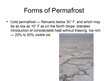
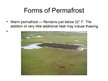
Forms of Permafrost
Cold permafrost — Remains below 30° F, and which may be as low as 10° F as on the North Slope; tolerates introduction of considerable heat without thawing. Ice-rich — 20% to 50% visible ice.

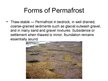
Forms of Permafrost
Thaw-stable — Permafrost in bedrock, in well drained, coarse-grained sediments such as glacial outwash gravel, and in many sand and gravel mixtures. Subsidence or settlement when thawed is minor, foundation remains essentially sound.

Author's comment
Send to email

Your name:

Enter an email address where the link will be sent:

Hi!
{Your name} suggests you to check out this eKönyvtár paper on „Permafrost and Soil Fluction”.

Link to paper:
https://eng.ekonyvtar.eu/w/310854

Send

Email has been sent